


Replacing an Obsolete Weighbridge at a High Security UK Site

When the 15-metre weighbridge at a high security UK site reached the end of its working life, the client faced a choice: chase spare parts for an ageing system, or start again with something built to last. They chose the latter, and MWS delivered a fully automated replacement in eight weeks.
Customer Profile
Our client operates a busy weighbridge at a high-security UK site. The weighbridge records the weight of traffic, cargo and waste moving on and off the site every day, supporting a constant flow of deliveries and collections. Given the nature of the site, security and confidentiality are treated as a priority in every aspect of its operations, including how weight data is captured and accessed. MWS worked closely with the client’s on-site teams throughout the project to ensure the new system met these requirements without disrupting day-to-day activity.

The challenge
The site had relied on the same 15-metre pit-mounted weighbridge for around twenty years, running on six analogue load cells beneath a concrete deck. When the bridge failed, MWS found the load cells were of an obsolete specification and next to impossible to source. Chasing spares for a system already at the end of its life made little sense, so the client chose to replace the weighbridge in full and modernise how the site captures and reports its weight data.
The brief was clear. The new system needed to be reliable and future-proof, with accurate, defensible records for waste leaving site, given the cost and risk attached to hazardous waste removal. Given the security requirements of a working at a high security site, it also needed to be accessible through a web browser rather than software installed locally on site PCs. And with two-way traffic, including a mix of left- and right-hand-drive vehicles, the automation needed to keep that flow moving without delay.

The Solution
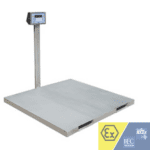
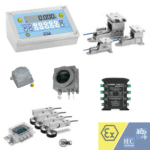
MWS replaced the failed weighbridge with a new 15-metre unit, purpose-made by partner Giropes in Spain. Giropes supplied the hardware, while MWS delivered the installation, civils management, electrical works, networking, cabin and PC. The new bridge runs on eight digital load cells, each operating independently rather than as part of a fixed set. A single cell can be swapped out and equalised on its own, answering the exact problem that put the old bridge out of action.
Heartland Contractors upgraded the pit foundations, installing new plinths and adjusting the pit depth to suit the new bridge. They also built a new weighbridge cabin, with electrical work completed by MWS and signed off with full certification. The cabin houses the site networking, PC and weight indicator, with two repeater displays mounted externally for reading weights from elsewhere on site.
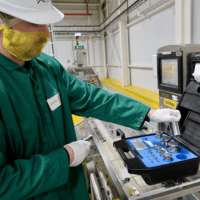
Four GST driver-operator terminals, along with traffic lights and cameras, now manage flow in both directions. A driver arrives, logs their vehicle and point of origin, records the waste or cargo involved, and completes an in-and-out weighing that captures the net weight and prints a ticket. Every weighing is passed up to the cloud, where operators retrieve it through a web app rather than local software, giving a clear audit trail while meeting the site’s security requirements.
Delivery
The full project, including civils and foundation work, took around eight weeks from order, with the weighbridge installation itself completed inside two. Commissioning was followed by a full calibration from a local weighbridge test unit. The client’s timescale was the main pressure throughout, and MWS delivered within it.
Outcome
- Resilience by design. Independent, swappable load cells mean any future fault can be resolved quickly, without waiting on obsolete parts.
- Trusted waste accountability. Digitally recorded weights give the client a defensible record of what leaves site.
- Secure, browser-based access. No local software to install or maintain, fitting the site’s security profile while keeping data easy to reach.
- Smooth two-way flow. Self-service terminals, lights and cameras keep left- and right-hand-drive vehicles moving with no bottlenecks.
RESULTS




Conclusion
For this client, the project removed a long-standing point of risk from the site’s operations. The new weighbridge is designed to avoid the spare-parts trap, and reporting now sits securely in the cloud rather than on local machines. Two-way traffic keeps moving.
MWS project-managed the scheme in full, working alongside Giropes for the hardware and Heartland Contractors for the groundworks. Together, the three partners delivered a complete, working system in eight weeks, from order to commissioning.