




Types of Laboratory Balances and Their Applications
What Is A Laboratory Balance?
A lab balance is a precision scale used in laboratories, research facilities, and pharmacies to measure the mass or weight of an object with a high degree of accuracy. While there are many different types, they all share this common purpose — and can also be used to measure other properties such as density, purity, and moisture content. In this blog post, we’ll explore the different types of laboratory balances and their various applications.
Applications of Laboratory Balances
Laboratory balances are used to measure the mass of objects, substances, and chemicals. Laboratory balances are used in a variety of applications, including:
- Research and development
Universities, biotech firms, and chemical companies rely on precise measurements when developing new materials, drugs, and formulas
- Quality control
Manufacturing industries such as aerospace, automotive, and electronics use lab balances to ensure components meet strict weight specifications - Production testing
Industries like plastics, textiles, and metal fabrication use balances to monitor and verify output consistency during the production process - Environmental testing
Government agencies, environmental consultancies, and water treatment facilities use balances to measure pollutants, sediment, and other sample materials - Pharmaceuticals manufacturing
Drug manufacturers and compounding pharmacies depend on highly accurate balances to ensure precise dosing and formulation of medications
- Food and beverage testing
Food producers, quality assurance laboratories, and regulatory bodies use balances to measure ingredients, verify nutritional content, and ensure product consistency
Types of Laboratory Balances
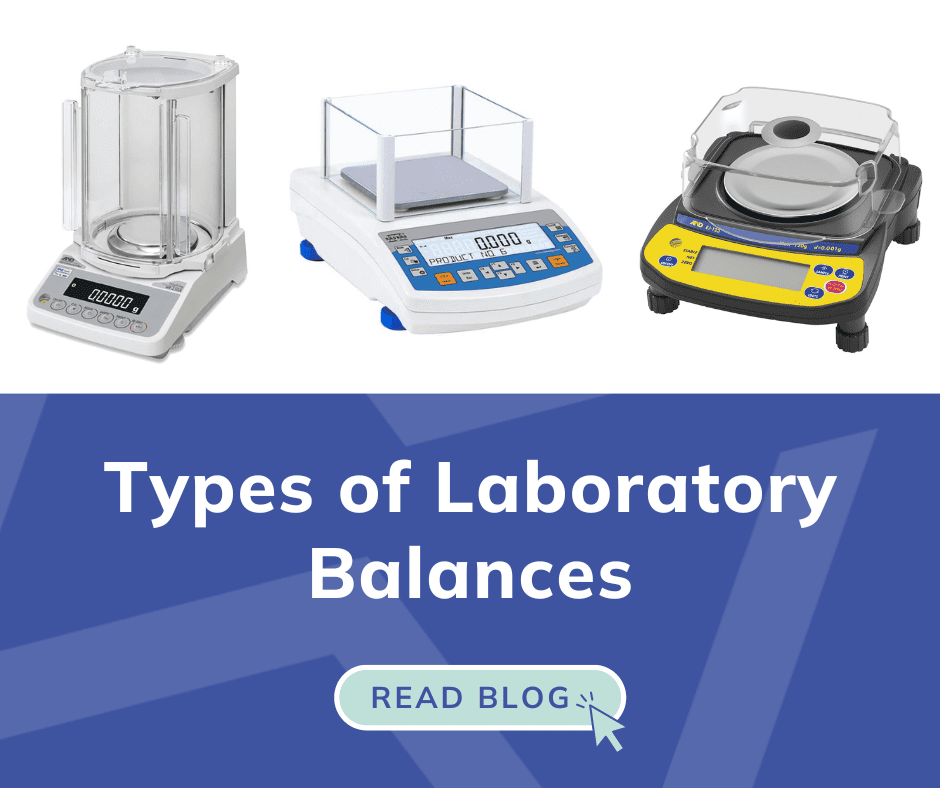
There are many different types of laboratory balances, each of which is designed for specific applications. The most common types of laboratory balances are:
1. Analytical Balances
Analytical balances are the most accurate type of balance and are typically used in research and development laboratories. They can measure objects with a mass as small as 0.001 grams (0.000035 ounces).
Analytical Balance Specifications
- Readability: 0.0001 g (0.0000035 oz) or better
- Sensitivity: 0.000001 g (0.000000035 oz) or better
To ensure accuracy, analytical balances are usually placed in a temperature-controlled room and must be calibrated regularly.
2. Precision Balances
Precision balances are less accurate than analytical balances but are still suitable for many laboratory applications. They can typically measure objects with a mass of up to 500 grams (17.64 ounces).
Precision Balance Specifications
- Readability: 0.001 g (0.000035 oz) or better
- Sensitivity: 0.0001 g (0.000035 oz) or better
Precision balances are not as sensitive to temperature changes as analytical balances, and they do not need to be calibrated as often.
3. Semi Micro, Micro & Ultra Micro Balances
Semi Micro Balances: These balances are used in pharmaceutical and chemical laboratories for measuring very small quantities of material. They can measure objects with a mass as small as 20 grams (0.705 ounces).
Micro Balances: These balances are used in pharmaceutical and chemical laboratories for measuring extremely small quantities of material. They can measure objects with a mass as small as 0.02 grams (0.000705 ounces).
They are commonly used in laboratories that work with chemicals and other substances that are harmful if inhaled or ingested. Microbalances must be placed in a temperature-controlled room and must be calibrated regularly to ensure accuracy.
Ultra Micro Balances: These balances are used in pharmaceutical and chemical laboratories for measuring extremely small quantities of material. They can measure objects with a mass as small as 0.002 grams (0.0000705 ounces).
To ensure accuracy, Ultra Micro Balances are usually placed in a temperature-controlled room and must be calibrated regularly.
4.Triple – Beam Balances
Triple-beam balances are the most common type of balance used in high school and college science laboratories. They can measure objects with a mass of up to 26.50 grams (0.93 ounces).
Triple-Beam Balance Specifications
- Readability: 0.01 g (0.00035 oz) or better
- Sensitivity: 0.001 g (0.000035 oz) or better
Triple-beam balances are not as sensitive to temperature changes as analytical and precision balances, and they do not need to be calibrated as often.
To ensure accuracy, triple-beam balances should be checked for levelness regularly and should be recalibrated if they are moved to a new location.
5. Equal Arm Balances
Equal arm balances are used in high school and college science laboratories. They can measure objects with a mass of up to 500 grams (17.64 ounces).
Equal Arm Balance Specifications
- Readability: 0.01 g (0.00035 oz) or better
- Sensitivity: 0.001 g (0.000035 oz) or better
Equal arm balances are not as sensitive to temperature changes as analytical and precision balances, and they do not need to be calibrated as often.
To ensure accuracy, equal arm balances should be checked for levelness regularly and should be recalibrated if they are moved to a new location.
Different Laboratory Balances for Different Applications
There are a variety of different types of laboratory balances that are used for different applications.
The major types are analytical balances; precision balances; semi micro, micro and ultra micro balances; triple-beam balances and equal arm balances.
The type of balance you use will depend on the accuracy required for your specific application. It is important to calibrate your laboratory balance regularly to ensure accuracy.
MWS deals with several types of laboratory balances. You can also check our online portal for laboratory scales that we currently produce.
To know more, get in touch with us today.